Metal to Blues
The second time we brought the kids to The Rock Shop, they walked in like they belonged there.
At least at first.
Before the bands started, the venue mostly looked like what it actually was: a shirt shop full of things children probably shouldn’t touch. For fifteen minutes Amy and I chased small bodies around racks of clothing and displays while trying to stop them from accidentally destroying inventory.
The room slowly filled while people waited for the first set. Someone working at the shop noticed the kids immediately and made sure people around us knew they were there so they didn’t get trampled. He was our guard. Support. Ear plugs appeared for the kids too. A few people adjusted themselves slightly to create more space.
None of it felt performative.
Just a room adapting to new variables in real time.
Then the music started.
The youngest immediately changed.
He’s normally the wild one, but he doesn’t love loud environments. Once the room filled with sound, he attached himself to Amy and stayed there most of the night, slowly watching from safety while trying to decide whether this place was exciting or overwhelming.
The older two warmed up faster.
Not instantly. It still took time. You could watch them gradually calibrating themselves to the room, studying the movement before joining it.
By the second set, something shifted.
Prisoner started playing and the boys moved toward the floor instinctively. Not because anyone encouraged them to, but because they had already recognized the pattern from the previous show: movement belongs here.
So they started “dancing” as my boy puts it.
Not real moshing. Just children constructing their own version of it. Running circles around each other, bouncing off invisible momentum and each other, trying to imitate the energy around them without fully understanding it yet.
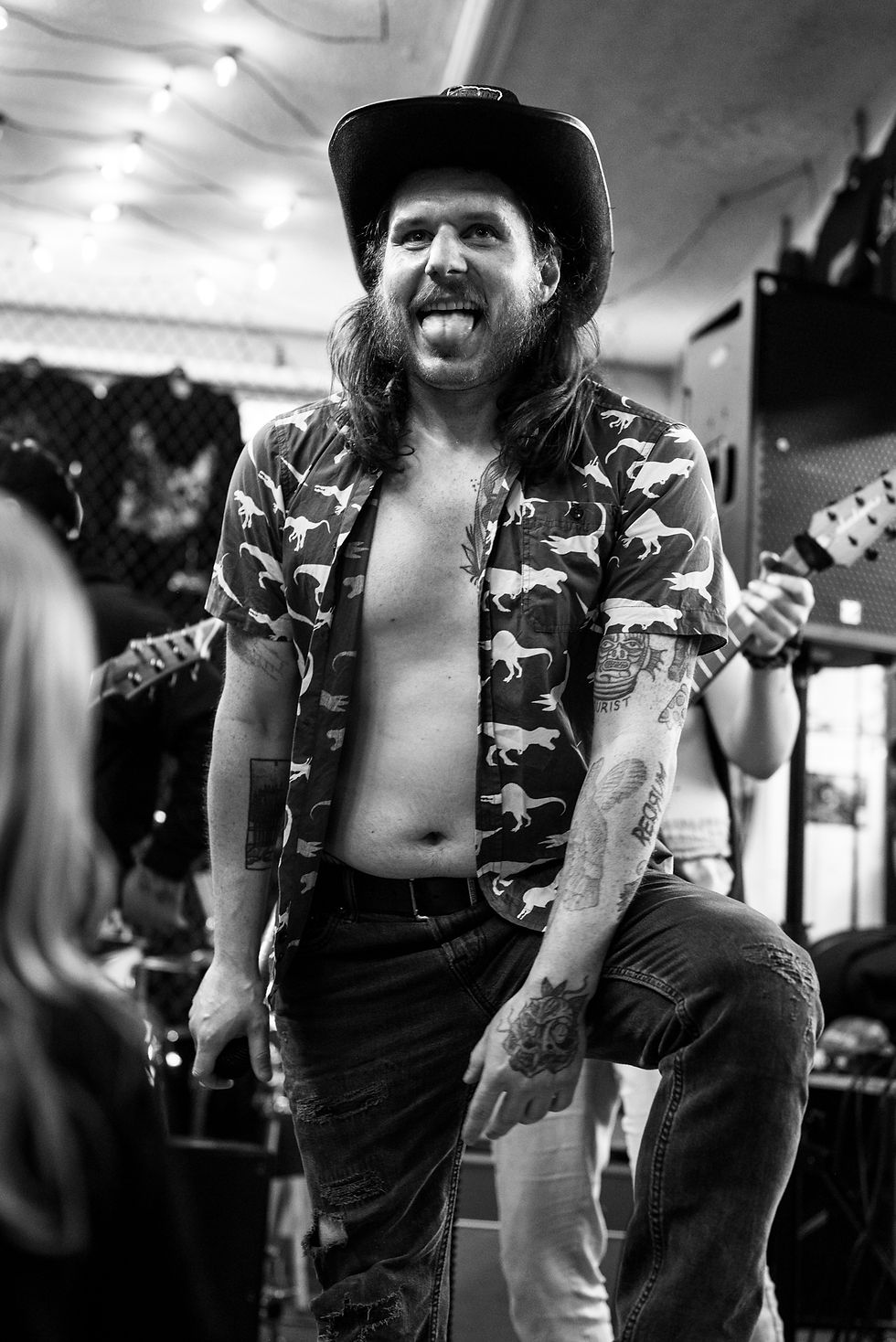
The vocalist noticed almost immediately.
At first he played into it from a distance. Then gradually carved out a small protected space for them near the corner of the floor, subtly redirecting the flow of bodies around them without killing the energy of the room. Mastery of the room. The frontman fulfilling his role.
At one point he handed them the microphone during a vocal part.
Neither kid knew what to do.
They both froze, not knowing what to do. I suspect they will get the grasp soon and belt into these collaborative mics in no time.
Again, the same contradiction appeared:externally aggressive environment, internally cooperative culture.
No one stopped the show for the children.No one sanitized the environment.The music stayed loud. The room stayed physical.
The space simply adapted.
That adaptation feels important.
Because outside these environments, modern public spaces are increasingly structured around separation:adults here,children there,performers here,spectators over there.
But scenes like this often blur those boundaries naturally.
Participation matters more than polish.
The kids weren’t treated as interruptions. They were temporarily absorbed into the ritual itself.
Eventually we had to leave because they’re still little kids and bedtime still exists no matter how heavy the breakdown is.
Pulling them out of the venue became its own small struggle. They didn’t want to go.
Not because they understood the music technically.Not because they idolized the bands.
They wanted to stay because they understood something simpler:
people here were engaged with each other. Kids thrive on this.
Our next show felt entirely different.
Amy and I ended up at The Blues Can while different bands rotated through short sets in front of an older, quieter crowd. Tables instead of open floor. More observation than participation.
The energy wasn’t hostile. Just contained.
People watched instead of entered.
Even attraction operated differently there.
Men openly approached Amy throughout the night, despite her being obviously out of their league. But the interactions felt less tense than performative. More like social ritual than genuine expectation.
She handled it easily.
At one point she jokingly pretended to be the bartender, offering to take someone’s money while they laughed through the interaction. Everyone seemed to understand the game being played.
And it also has to be noted, Amy talks a big game. Especially when it comes to billiards. But I suppose everyone gets a little nervous sometimes, and while Amy was confidently beating admirers off with a stick, I cleaned up the table on her.
At The Rock Shop, the room had functioned almost like a temporary organism.
At Blues Can, people remained more individual. Separate tables. Separate conversations with occasional crossing into other’s circles to try to connect. Separate intentions orbiting the music rather than dissolving into it.
Neither environment was better.
But they revealed different things about how people gather.
Some scenes create spectators.
Others create participants.
And children notice the difference faster than adults do.


Comments